



Plasma-Pulse Geo-Drilling (PPGD)
Development of Low-Cost Deep-Drilling System in Hard Rock, an Innosuisse project
 Prof. Dr. Martin O. Saar
- HSProf. Dr. em. Hans-Olivier Schiegg(SwissGeoPower)Co-PI
- Dr. Mohamed EzzatDoctoral Student
- Dr. Daniel VoglerOberassistent
- Dr. Benjamin AdamsPostdoc
- Dr. Edoardo RossiPostdoc
- Dipl.-Ing. Jascha Börner(Fraunhofer IEG)
- Dipl.-Ing. Volker Wittig(Fraunhofer IEG)
Jul 2018 – Jun 2023
28305.1 PFIW-IW, PFFS-21-48


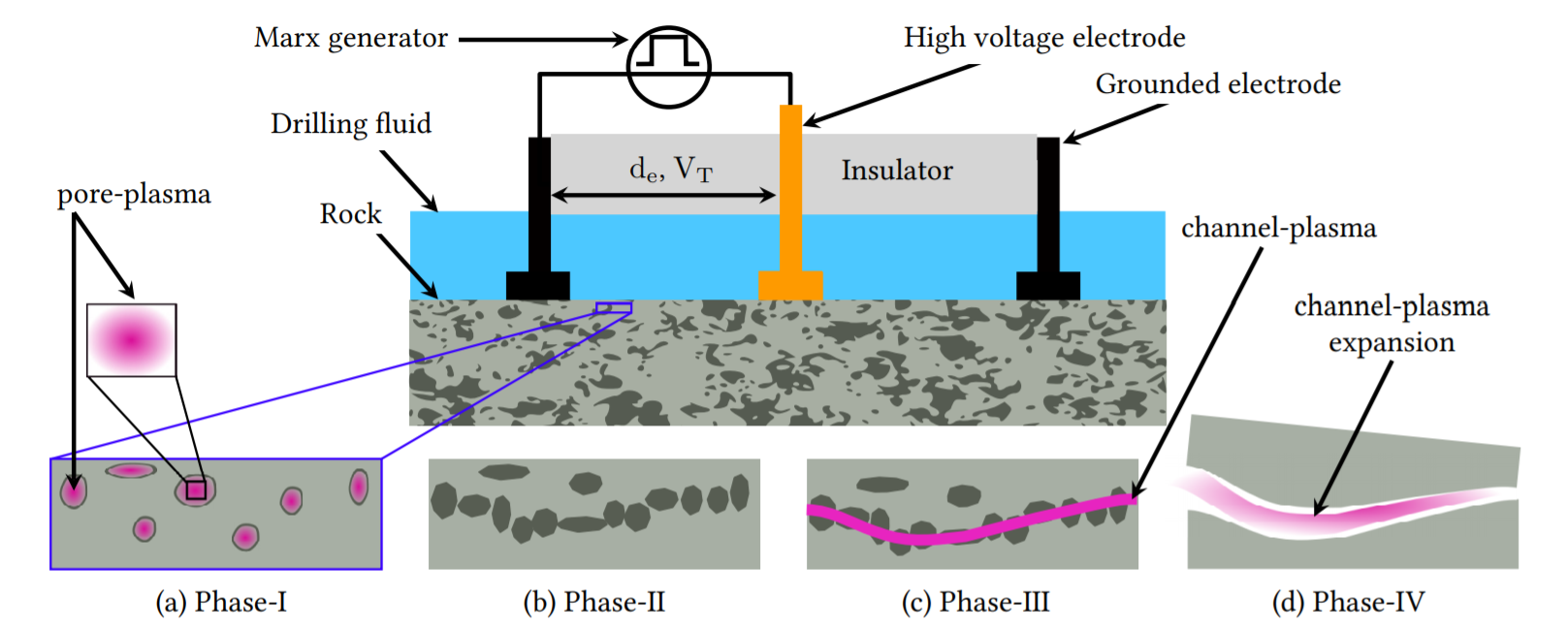
Fig:Plasma Pulse Geo-Drilling (PPGD)
Introduction
Geothermal energy is, in principle, an almost unlimited energy resource that exists everywhere and is available around the clock. To generate electricity with enhanced and advanced geothermal systems, however, we need access to deep, typically crystalline, basement rock with temperatures of 150 °C or more. In most regions of Europe, where the geothermal gradient is about 35 °C/km or less, such temperatures occur at depths greater than 5 km. Conventional mechanical rotary drilling is too expensive: it requires a lot of energy, and the bit wears quickly, leading to long tripping times to change worn bits.
Plasma-Pulse Geo-Drilling (PPGD) is a contactless alternative. It uses high-voltage impulses (>200 kV) with short rise times (<0.5 µs) to fracture rock without mechanical abrasion. Two electrodes transmit the impulses to the rock surface, where they drive an electrical discharge through the rock. The resulting plasma channel raises the internal pressure and creates tensile stresses that eventually fracture the rock. Without mechanical abrasion or a drill string, PPGD is expected to extend bit life and shorten tripping times, lowering drilling costs.
Objectives
The project, Development of Low-Cost Deep-Drilling System in Hard Rock, aimed to:
- understand the physics of PPGD, from electrical breakdown and plasma formation to rock fracture, using numerical models on the pore scale;
-identify the key rock properties and operating conditions that control the process;
- test whether PPGD is viable under 5 km-deep wellbore conditions (temperatures up to 150 °C and pressures up to 150 MPa) in laboratory experiments.
Related Projects
- PPGD Modeling of Plasma Channels in Rock (active)
- AEGIS-CH: Advanced geothermal systems to improve the resilience of the energy supply of Switzerland (completed)
- Modeling thermal spallation drilling (completed)
- Combined Thermo-Mechanical Drilling (CTMD) technology (completed)